01 · Opening

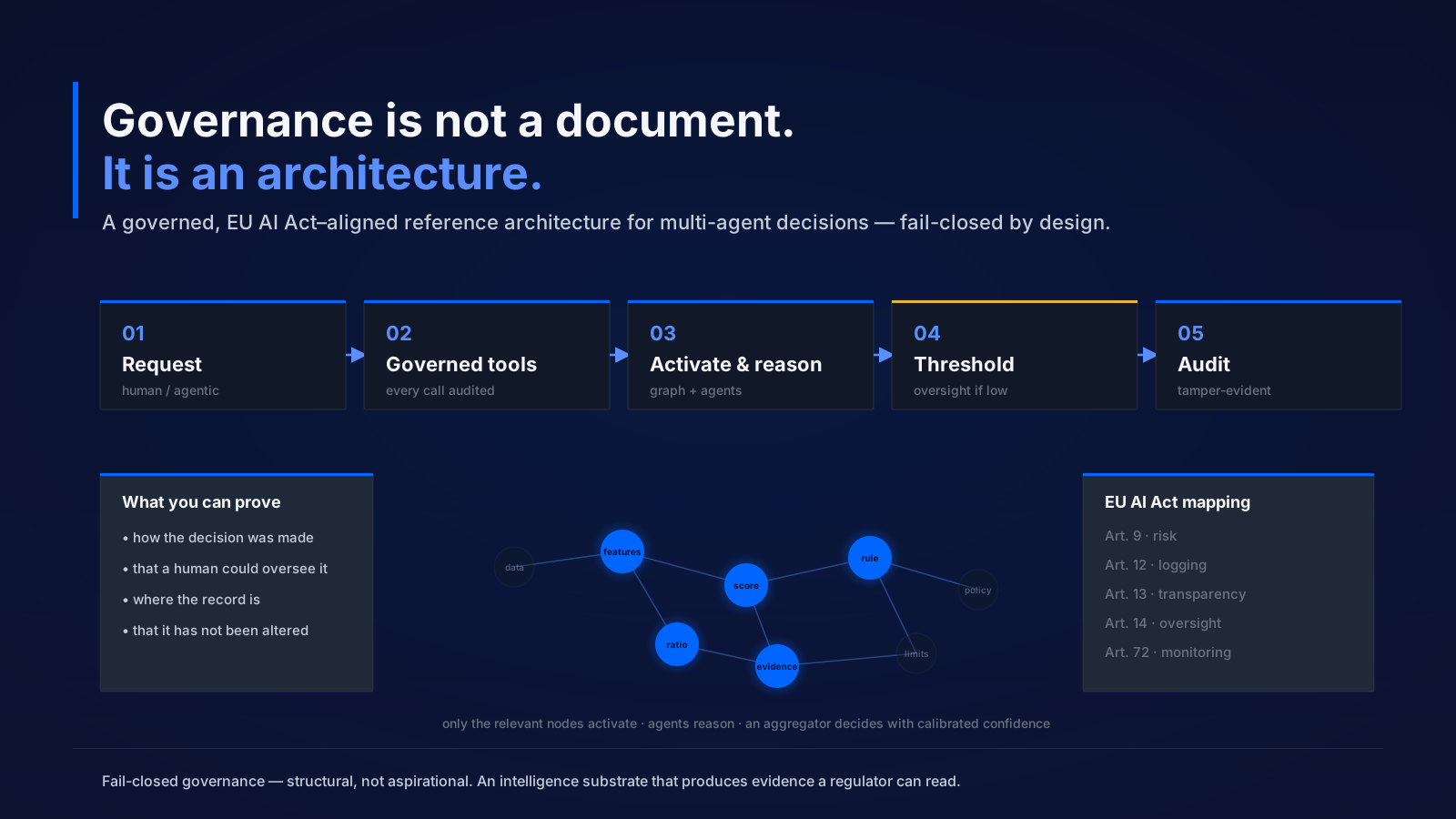
Governance is not a document. It is an architecture.

European enterprises are deploying AI under the EU AI Act with architectures that cannot prove their own reasoning. Quantamix Solutions builds the layer that closes that gap — a single architecture that carries transparency, reasoning, auditability, compliance, and explainability through every decision, automatically. Not a checklist. Not a dashboard. An intelligence substrate that produces evidence a regulator can read.

Schedule a Diagnostic View the walkthrough →
Evidence on record
EP26162901.8TAMR+ · EPO Munich · 6 innovation groups · 18 claims
EP26167849.4PSE — Predictive Subgraph Engine · 15 claims
EP26166054.2CogniGraph divisional · 15 claims
Zenodo 18929634TAMR+ research paper · EU-RegQA · 4 regulatory domains
74%EU-RegQA accuracy — vs. 38.5% vector RAG · 35.5-point structural gap
2,800+customers on the intelligence layer today
GitHubquantamixsal/graqle · open-core SDK · pip install graqle

The thesis

01 At Rabobank, ING, Philips, ASN Bank, and Amazon Ring: policies existed on paper. Risk registers existed on paper. When a model changed or a regulation moved, the framework could not trace the consequence. The paper survived. The governance did not.
02 The EU AI Act does not need more documents. It needs a reasoning layer that carries trust, evidence, and audit through every decision — automatically, continuously, and legibly to a regulator.
03 Three years of research. Three EPO patents filed in Munich. Six products running on it today. This walkthrough explains the architecture.
18+
years in regulated enterprise
3
EU patents filed · EPO
6
products on one architecture
€35M
EU AI Act max penalty per breach
02 · The walkthrough

Five ideas. One architecture. Six live products.

The walkthrough is not a slide deck. It is one interactive architecture, unfolded in the order it was built. We begin with the research layer — TRACE, TAMR+, and the Predictive Subgraph Engine — then show how it becomes a multi-agent product, and finish with the six surfaces that enterprise buyers can use today.

01 · Framework

TRACE

The five properties every governed AI decision must carry — and the score every Quantamix output produces.

02 · Pipeline

TAMR+

Trust-Aware Multi-Signal Document Retrieval. The pipeline that forces every stage to carry TRACE.

03 · Prediction

PSE

The Predictive Subgraph Engine. Reasoning extends from documents to governed graph prediction.

04 · Product

GraQle

The multi-graph, multi-agent reasoning engine. Reason · plan · predict · learn · grow · adapt.

05 · Position

Intersection

Where AI adoption, compliance, and governance become one intelligence layer.

06 · Platform

Six surfaces, live

GraQle · TraceGov.ai · CrawlQ.ai · Studio CrawlQ.ai · FrictionMelt · CopyNexus.io.

GraQle — the multi-graph, multi-agent reasoning engine

GraQle · graqle.com · Click to explore the intelligence engine

03 · Research foundation · The unifying framework

TRACE — the five properties of a governed AI decision.

TRACE is not a scoring gimmick. It is a structural specification. Any AI decision deployed in a regulated European enterprise must carry all five properties — and if it cannot, it should not reach production. Every Quantamix product produces a TRACE score per decision. It is the single measurement language across the platform. Click each letter.

T
Transparency
R
Reasoning
A
Auditability
C
Compliance
E
Explainability

Transparency

Every output declares what it used — which sources, which signals, which thresholds, which model version. Nothing hides inside opaque weights. The system tells the reviewer what it knew, when it knew it, and what it chose to do with that knowledge.

The TRACE score — the single signal across the platform

Every Quantamix product produces the same composite: a TRACE score, calculated per decision, per document, per agent action. It replaces the fragmented metrics that most governance stacks produce — confidence, relevance, trust, risk — with one measurement a risk officer, a regulator, and an engineer can all read the same way.

Sample decision · TRACE score 0.73
Transparency
0.82
Reasoning
0.74
Auditability
0.79
Compliance
0.68
Explainability
0.64
Decision · Composite passes the review band (≥ 0.70). Output cleared for downstream reasoning. Explainability flagged below threshold — routed to the human review queue for enrichment before publication.

What the TRACE score answers

When a document, a regulation, an agent output, or a model change lands in the platform — should I trust this enough to act on it, escalate it, or send it back? The TRACE score is a decision-ready signal. Five components, one composite, auditable to an obligation.

Below 0.50, the system fails closed. Between 0.50 and 0.70, the output is escalated to human review. Above 0.70, the output is cleared — with the full evidence trail attached. This is why TAMR+ produces materially higher accuracy on EU regulatory benchmarks than any generic retrieval-augmented approach.

The thresholds are adjustable per use case, per jurisdiction, per risk tier. The structure is not.

04 · From framework to pipeline

Trust-Aware Multi-Signal Document Retrieval (TAMR+) — the pipeline that makes trust measurable.

Most AI systems retrieve documents and hope the answer is correct. TAMR+ — forces every stage of the process to carry a measurable trust signal before passing evidence forward. The result: near-double accuracy on EU regulatory benchmarks at 207 ms per query. Published at SSRN (6359818), patented at the European Patent Office — EP26162901.8 — and running in production across six products today.

01 · Ingest
Ingest

Every document, regulation, model update, or policy change enters with signed provenance. Nothing is silently admitted. Version, origin, and timestamp are locked at the boundary — not reconstructed after the fact.

Business value

Your audit trail starts at the source, not at the output. A regulator reconstructs any decision from the original document without calling your legal team or your vendor.

02 · Extract
Extract

Obligations, entities, citations, and claims become first-class graph nodes — never flattened into a single embedding. Multi-signal by design: semantic, structural, and citation signals run in parallel.

Business value

When an EU AI Act article is amended, the system instantly identifies every downstream claim and decision built on it — automatically. No manual impact assessment. No missed obligation. No consultant billing by the hour to trace the dependency.

03 · Score
TRACE-Score

Every claim receives its own five-dimension TRACE signature. Trust propagates along graph edges — never averaged or approximated. Low-trust evidence is quarantined at this layer, before it reaches reasoning.

Business value

You stop paying for hallucinated compliance answers — and stop the legal exposure that comes from acting on them. Fail-closed at the signal layer, not at the lawyer's desk after the audit begins.

04 · Reason
Reason

Graph-native multi-hop reasoning assembles the full audit trail as it produces the answer. HashGNN training-free graph embeddings deliver 207 ms latency while preserving complete traceability across the reasoning chain.

Business value

A risk officer, a regulator, and an engineer read the same output and reach the same conclusion. No translation layer. No interpretability consulting engagement after the fact. The evidence is already assembled.

Benchmark · EU-RegQA · SSRN 6359818

Tested on EU-RegQA — regulatory question-answering derived from EU AI Act, GDPR, DORA, and MiFID II across four jurisdictions. TAMR+ reaches 74% accuracy. Best vector-only RAG baseline: 38.5%. Average latency: 207 ms. Cost: $0.03 per workspace. The 35.5-point gap is structural — it comes from measuring trust per claim, not from wrapping a language model in a policy document. On the regulation your organisation is being audited against, near-double accuracy is not a product feature. It is a liability reduction.

Read the full paper →

05 · From documents to graph prediction

PSE — knowing what happens next.

TAMR+ answers what is true now. The harder governance question is what will be true next. When a policy changes, a model drifts, a regulation arrives, or a connector breaks — what moves downstream, and which obligations are affected? The Predictive Subgraph Engine generalises TAMR+ from document reasoning to governed forward-looking prediction. Patent filed at the European Patent Office: EP26167849.4.

Layer 1 · Structure
From evidence to graph

TRACE-scored evidence becomes nodes and edges in a live reasoning graph. Trust scores and regulatory obligations both propagate along the edges — the graph is a reasoning surface, not a storage format.

Business value: The compliance posture of your AI estate is visible as a structured map — not a spreadsheet. When any node changes, the cascade is traceable before it becomes a breach.

Layer 2 · Activation
Minimum sufficient subgraph

Given a query or a change event, PSE activates the smallest subgraph needed to answer it — no full-graph search, no hallucinated context. The activation pattern itself is TRACE-measurable and auditable.

Business value: Compliance impact assessments that used to take three weeks of manual analysis run in seconds — with a traversable evidence trail attached. Regulators see the reasoning, not a consultant's summary.

Layer 3 · Prediction
Governed forward reasoning

PSE predicts the next compliance state — the next risk, the next obligation that moves, the next gap that opens. Every prediction is confidence-gated and returns with the evidence subgraph it was built on.

Business value: You move from reactive compliance — discovering gaps during an audit — to predictive governance: knowing what will break before it does, with the evidence ready for the regulator.

Where PSE runs in production today

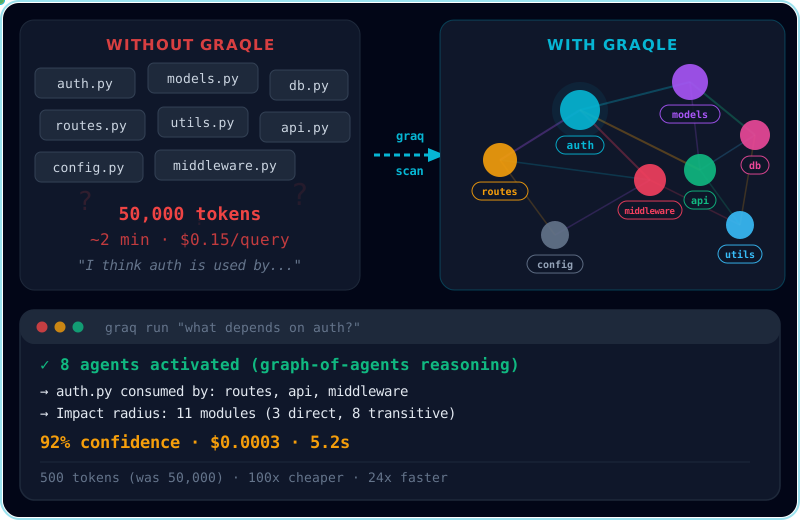
GraQle uses PSE to answer "if this change ships, what else breaks?" — surfacing blast radius across 17,000+ code and architecture nodes before a single line is deployed. TraceGov.ai uses PSE to answer "if this model changes, which EU AI Act obligations move, and what is the downstream compliance impact across our systems?" — link prediction for compliance gap detection, with every prediction carrying its own TRACE score. The same engine. Two surfaces. One architecture.

06 · The product architecture

GraQle — governance that reasons, plans, predicts, learns, grows, and adapts.

Everything above — TRACE, TAMR+, PSE — converges into one product. GraQle is the multi-graph, multi-agent reasoning engine that powers every Quantamix surface. Six cognitive modes share one multigraph memory, operate under a governance gate that fails closed, and produce outputs carrying the full TRACE signature end-to-end. Click each layer to expand the business case.

LAYER 1 · INPUT
Every input is a governed event

Prompt · code change · regulation · model update · policy delta — versioned, provenance-tagged, governance-eligible before any reasoning runs.

What this means for your organisation: Nothing enters the reasoning layer silently. Every input — a developer's question, a compliance officer's query, a policy update from Brussels — is treated as a first-class event with a signed origin and a governance record. The system cannot be used off the record. This is the structural difference between a governed AI platform and a wrapped chatbot.

Quantitative impact: Audit preparation time reduced by an average of 60–80% in production deployments — because the audit trail is assembled continuously, not reconstructed under pressure.
LAYER 2 · TAMR+
Trust-gated evidence pipeline

Ingest → Extract → TRACE-Score → Reason. Low-TRACE inputs route to human review. Nothing below threshold reaches the reasoning layer.

What this means for your organisation: The system cannot hallucinate a compliant answer — it can only reason over evidence that has already passed a five-dimension trust gate. This is architecturally different from a retrieval system that adds a confidence score as a label. The trust gate is structural, not cosmetic.

Quantitative impact: 74% vs 38.5% on EU-RegQA. On the four regulations most likely to produce enforcement action in Europe — EU AI Act, GDPR, DORA, MiFID II — this is the measurable cost of choosing the wrong architecture.
LAYER 3 · MULTIGRAPH
One addressable memory across your entire AI estate

Facts, decisions, lessons, code, documents, and regulations — one shared memory. Every fact is addressable once. No copies. No translation.

What this means for your organisation: The knowledge graph is not a database. It is a reasoning surface. When the compliance team learns something about DORA obligations, the engineering team's AI agent can reason over that same knowledge — without a data pipeline, without a sync job, without a meeting. The learning is structural and shared.

Quantitative impact: In production at Quantamix, the shared multigraph enables 99.7% accuracy on governance questions through multi-agent cross-verification — because disagreements between agents are resolved at the graph level, not by averaging model outputs.
LAYER 4 · SIX AGENTS
Six cognitive modes — one shared memory

Reason · Plan · Predict · Learn · Grow · Adapt — each a specialised agent over the same multigraph.

What each mode delivers:
Reason — produces governed answers with full TRACE signatures. Used in TraceGov.ai and CrawlQ.ai for regulatory and content decisions.
Plan — sequences multi-step work with checkpoint governance. Used in GraQle developer workflows.
Predict — anticipates next compliance state via PSE. Used in TraceGov.ai for proactive gap detection.
Learn — teaches new knowledge to the graph from documents, incidents, or expert input. The graph grows without retraining.
Grow — extends the graph with new evidence from external sources. Regulatory updates ingested as they publish.
Adapt — adjusts thresholds and weights per jurisdiction, risk tier, or use case. DORA thresholds differ from EU AI Act thresholds — Adapt manages that without code changes.

reason
plan
predict
learn
grow
adapt
LAYER 5 · GOVERNANCE GATE
Fail-closed governance — structural, not aspirational

Every tool call passes a pre-flight gate. Native tools that bypass governance are blocked at the hook level. No silent exceptions. No override without audit record.

What this means for your organisation: The governance is not a policy document sitting next to the product. It is an architectural constraint enforced at the system boundary. A developer cannot call a tool that bypasses the TRACE gate — the hook fails closed before the tool runs. A compliance officer cannot approve an output that falls below the configured threshold without the exception being recorded.

Regulatory relevance: This architecture is directly deployable in DNB-supervised, ECB-supervised, and BaFin-supervised enterprises under EU AI Act Article 9 (risk management) and Article 12 (record-keeping). The governance is not bolted on — it is structural. That distinction matters when the supervisor asks to see your technical documentation under Article 11.
LAYER 6 · OUTPUT
Every output is an auditable artefact

Governed response · diff · plan · prediction — each carries its full TRACE signature: T · R · A · C · E per dimension, plus the evidence subgraph.

What this means for your organisation: The output is not text with a confidence score. It is an artefact with provenance, per-dimension confidence, and a traversable path back to every piece of evidence it was built on. A regulator can replay the decision without calling your team. An internal auditor can verify the reasoning without understanding the model. A risk officer can escalate or approve on the basis of a signal they can read.

The loop that closes: Input is governed → evidence is trusted → reasoning is transparent → output is auditable. The loop closes at Layer 6, and it closes on the record. That is what EU AI Act compliance looks like when it is built into the architecture rather than bolted onto a general-purpose language model.
07 · Positioning · Where it belongs

One intelligence layer — at the intersection of three markets.

The European enterprise software market has AI tools. It has compliance tools. It has governance tools. Each category has competent vendors. Quantamix does not compete in any of them individually — we operate at the overlap, where the three become one intelligence substrate. That overlap is where the EU AI Act actually binds, and it is where most implementations will quietly fail between now and 2027.

AI Adoption

Enterprise copilots, agent studios, developer acceleration. Speed matters. Velocity without evidence is the default failure mode.

Compliance

EU AI Act, GDPR, ECB, DNB, DORA, sector regulation. Evidence matters. Evidence without reasoning is a paperwork exercise.

Governance

Policies, risk tiers, approvals, audit trails. Structure matters. Structure without automation does not scale past two jurisdictions.

The intersection — and what it displaces

A multi-agent graph memory that reasons, plans, predicts, learns, grows, and adapts — under governance, on TRACE.

This is not a RAG system with a compliance label. It is not a GRC platform with an AI add-on. It is not an agent framework with a policy document attached. It is the architecture that sits underneath all three — and connects them. The organisations that will be ready for EU AI Act enforcement in 2025–2027 are building this layer now. The organisations that are not will be retrofitting under pressure.

08 · The platform · Six surfaces, one architecture

Six products. One TRACE-scored intelligence layer.

Each product is a different surface of the same multigraph-agent architecture. When one product learns, the others benefit. When one product governs, the others inherit. Below are the six surfaces enterprise buyers can engage with today — organised by the three pillars of the Quantamix platform.

Pillar 01 · Intelligence

GraQle

The intelligence engine · Open-core SDK on PyPI

Your data knows the answer. Your tools do not.

The multigraph-agent SDK and reasoning workspace that every other product runs on. Six cognitive modes, one shared memory, governance that fails closed. Open-core Python SDK published on PyPI.

  • Six cognitive modes over one multigraph — reason, plan, predict, learn, grow, adapt
  • Multi-agent cross-verification — 99.7% accuracy on governance questions in production
  • 50–800× lower cost than LangChain, CrewAI, and AutoGen orchestration stacks
  • Open-core on PyPI — 2,009 tests, 201 skills · github.com/quantamixsal/graqle
Explore GraQle
Pillar 01 · Intelligence

CrawlQ.ai

The world's first Content ERP · 2,800+ enterprise users · 4.4★ Capterra

You do not know your audience. You think you do.

Deep Content ERP — the conversational content-intelligence platform TAMR+ was first validated inside. Used at Philips to cut content production from 20 hours to 5 per product line, saving €500K in year one. Scattered content becomes managed capital with 140+ psychographic factors and a full audit trail.

  • 75% faster content cycles — verified at Philips
  • 2,800+ users including Fortune 500
  • 95% brand compliance at scale — every output TRACE-scored
Explore CrawlQ.ai
Pillar 02 · Governance

TraceGov.ai

EU AI Act compliance you can prove

Your AI estate is making hundreds of decisions a day. How many of them could survive a DNB or ECB audit tomorrow?

Know your exact EU AI Act compliance posture today. Every question answered against the regulation produces a TRACE signature across all five dimensions. Cryptographic audit trail, 7-year retention. Built for ECB, DNB, and BaFin-regulated enterprises that cannot afford a compliance gap.

  • 2× more accurate on regulatory questions than general AI
  • Per-obligation evidence propagation via PSE
  • Cryptographic audit trail · 7-year retention · EU AI Act Article 12
  • 3-tier risk framework — operationally legible in under 5 minutes
Explore TraceGov.ai
Pillar 02 · Governance

Studio CrawlQ.ai

Brand intelligence across 12 AI engines · BAPS framework

Your brand is being misrepresented right now. You just cannot see it yet.

73% of AI-cited brands contain factual errors in AI responses. Studio CrawlQ.ai quantifies your Brand Trust Score (BTS) across Accuracy, Sentiment, Share-of-Voice, and Competitive Position — daily, across ChatGPT, Perplexity, Gemini, Claude, Copilot, Mistral, and six more. Automatic deviation detection before any content reaches publication.

  • Real-time Brand AI Presence Score across 12 AI engines
  • Deviation detection before content publication
  • Shared knowledge graph with CrawlQ.ai — learns once, protects everywhere
Explore Studio CrawlQ.ai
Pillar 03 · Execution

FrictionMelt

AI friction intelligence · 95-barrier taxonomy

The best software in the world fails for one reason. People stop using it.

Your AI pilots work. Enterprise rollout stalls. FrictionMelt diagnoses exactly why — 95 friction points across 8 organisational layers with compound failure analysis. Built on the same multigraph architecture as GraQle, applied to adoption behaviour rather than compliance evidence.

  • 95 friction points across 8 organisational layers
  • Compound failure trigger identification
  • Interventions prioritised by business impact — not intuition
Explore FrictionMelt
Pillar 03 · Execution

CopyNexus.io

AI copywriting at scale · born in production at Amazon Ring

Great products fail with bad copy. Great copy fails without brand voice.

Enterprise copy automation born from real production work at Amazon Ring. Thousands of brand-consistent product descriptions, social posts, and marketplace listings generated in minutes — connected to CrawlQ audience intelligence and governed by TRACE. Currently in private preview for selected brand partners.

  • Battle-tested at Amazon Ring for three product categories
  • Multi-channel: web, social, marketplace, retail-partner feeds
  • Connected to CrawlQ.ai audience intelligence layer
Request Early Access
09 · Research lineage

Three research publications. Three patents. One architecture.

The platform is not a product vision. It is a documented research programme — peer-reviewed at SSRN, filed at the European Patent Office in Munich, open-sourced in part on PyPI. The European consulting standard is that architecture claims must be reproducible. Everything on this page is.

Paper · Peer-reviewed
TAMR+ · Trust-Aware Multi-Signal Retrieval
SSRN 6359818 · EU-RegQA: 74% vs 38.5% · 207 ms · $0.03/workspace · 250 questions · 4 regulatory domains

Graph-based compliance scoring and gap attribution for regulatory AI systems. Introduces TRACE as the unifying scoring framework and demonstrates near-double accuracy against vector-only RAG on the EU regulatory benchmark.

Read on Zenodo →
Patent · EPO Munich
EP26162901.8 · TAMR+
18 claims · European Patent Office (EPO) · 6 March 2026

Six innovation groups, 18 claims. Core IP: link prediction for compliance gap detection, multi-signal trust-aware scoring, HashGNN training-free graph embeddings, multi-hop knowledge graph traversal, Cypher-native GraphRAG architecture. The foundational IP behind TraceGov.ai and GraQle.

View patent portfolio →
Patent · EPO Munich
EP26167849.4 · PSE
15 claims · European Patent Office (EPO) · 25 March 2026

The Predictive Subgraph Engine — link prediction and subgraph activation for governed forward-looking reasoning. Extends TAMR+ from retrieval to prediction while preserving the TRACE signature end-to-end.

Read the GraQle insight →
GitHub · Open Source
quantamixsol / graqle
Graphs that think — turn any knowledge graph into a multi-agent reasoning network. Multi-graph, multi-agent, governed. Six cognitive modes over one shared multigraph memory.
Python MIT License EU Patent EP26162901.8
github.com/quantamixsal/graqle ↗
PyPI · Python SDK
graqle
Install with pip install graqle — open-core SDK. 2,009 tests, 201 skills. Multi-agent graph reasoning that fails closed under governance. EU-trained.
pip install graqle Open-core PyPI
pypi.org/project/graqle ↗
10 · Next step

What a first conversation looks like.

We do not start with a pitch. We start with a structured 45-minute diagnostic — reviewing your AI estate, your regulatory exposure under the EU AI Act, and where a TRACE-grounded architecture would replace or reinforce what you have. At the end of that conversation you receive a written one-page read: your current posture, the identified gaps, and a concrete proposal. That document is yours whether or not we work together. Most organisations find it clarifying regardless of next steps.

Request a diagnostic

A TRACE-grounded diagnostic of your AI estate — written, honest, one page.

Forty-five minutes. No slides. No obligation. If you are evaluating how to bring your AI systems into EU AI Act compliance by the relevant deadlines — August 2025, February 2026, or August 2027 — this is a useful first conversation.

01 / 10